Hundreds of thousands of Arizonans lack access to the tools they need to find work, manage their health, and learn online. The Institute of Digital Inclusion Acceleration (IDIA) is a nonprofit dedicated to closing that digital divide.
“We want everyone to meaningfully and fully participate in the digital world,” said Dr. Erin Carr-Jordan, president and CEO of IDIA. “The goal is for people to not just have access and opportunity, but to participate safely and have the level of digital agency that lets them benefit from all the possibilities.”
Systemic poverty deepens the digital divide
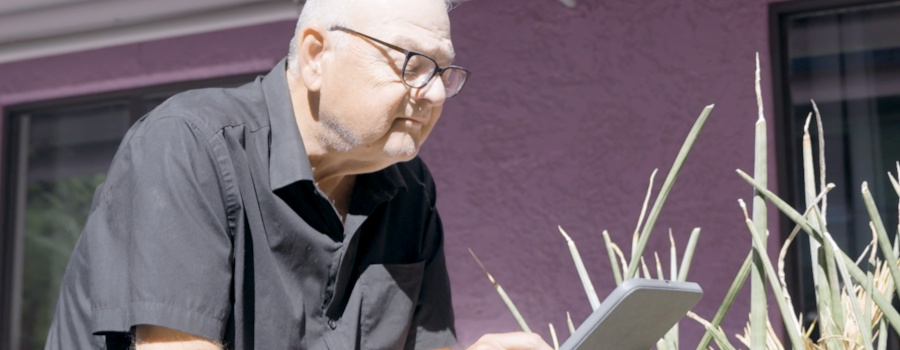
The possibilities were just out of reach for John Hoffman, whose landlord sold the house where he was living. As a result, he landed in a large, chaotic homeless shelter in Phoenix. Unprepared for his new situation, he focused all his energy on survival.
“You're dealing with every kind of person. You can't sleep at night. You’ve got to make sure everything you have is locked up so it doesn’t get stolen while you're sleeping,” Hoffman said. “This was my first time being homeless, so it wasn't like I was used to that kind of environment.”
Hoffman knew that accessing digital resources could help him find stable housing and work, but doing so was nearly impossible in an environment where he was disconnected from basic services and reliable technology. His experience illustrates how systemic poverty deepens the divide: people in vulnerable situations, like the unhoused, often lack reliable internet, devices, and digital skills, furthering their isolation.
Members of these and other vulnerable populations might have limited or no transportation or struggle with physical and mental health challenges, facing even steeper barriers to digital inclusion. Many have also developed deep skepticism born from years of hardship and disconnection.
“The pace of technology and the acceleration of innovation was happening so quickly that it was exacerbating the digital divide,” Carr-Jordan said. “If there wasn’t something done with a sense of urgency, folks weren’t just going to be left behind—the situation would be unrecoverable.”
Hoffman is far from alone. People experiencing homelessness are disconnected from healthcare and social services. Meanwhile, at-risk youth lack access to additional education and support systems. Communities in lower socioeconomic areas often lack access to reliable internet, devices, and digital skills, furthering the digital divide.
“Everywhere we go, people are experiencing systemic, often generational poverty. When people are poor, it makes everything in life harder,” Carr-Jordan said.
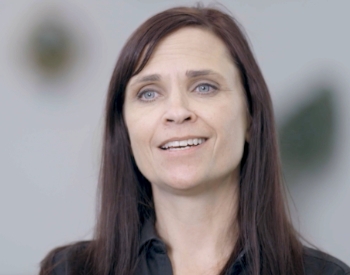
The collaboration with Verizon shows that when business and nonprofits come together with a mutually identified goal of doing good, mountains can be moved.
Dr. Erin Carr-Jordan, President and CEO, IDIA
Tech-enabled hubs, mobile units, and strategic partnerships
Creating pathways to digital participation requires the IDIA team to listen and understand the issues that lead to inequity. As a sector- and stakeholder-agnostic organization, IDIA partners with government, academia, the education system, job programs, and healthcare providers. Together, they support communities with everything they need to grow in today’s connected world.
At the core of this work is IDIA’s partnership with Verizon.
“Partnerships undergird everything we do,” Carr-Jordan said. “I can’t overstate how important partnerships—and the co-creation that happens because of the partnerships—are to the success of IDIA, but more importantly, the community.”
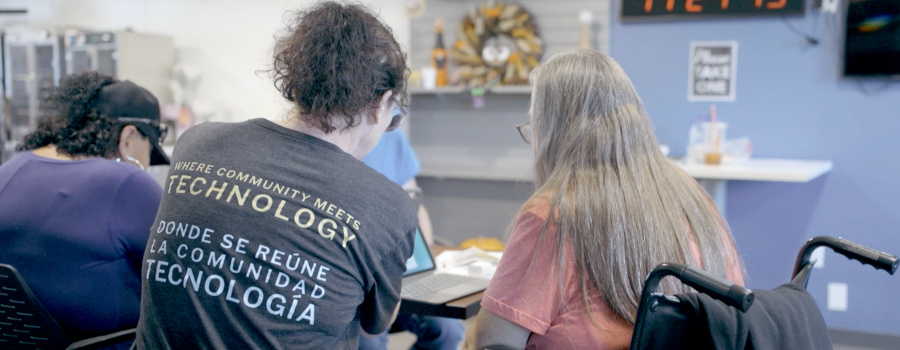
Hoffman eventually found community at The Haven, an emergency shelter that offered safety, privacy, and the resources to start rebuilding. The Haven is an example of IDIA’s model at work. Their organizational model includes:
- Hives, physical learning hubs where people can access support and gain hands-on experience with state-of-the-art tech
- Mobile units with teams and vehicles that deliver hive offerings directly to communities that largely lack connectivity
- Temporary Hives, partner sites where IDIA’s digital navigators and team host events and learning experiences
Hotspots and connectivity have supported programs for at-risk youth and seniors, along with those that promote physical and behavioral health. The Centers for Disease Control and Prevention (CDC) even cited the pop-up model as an exemplary program for its innovative and replicable impact.
“The idea was that if we could get people access to the technology and the connectivity and the care they needed, we could improve the quality of their life,” Carr-Jordan said. “The feedback that we got across the board was that these are incredibly meaningful programs.”
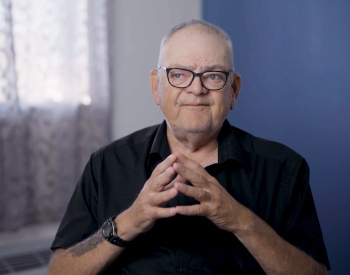
I have a house now instead of a place to stay.
John Hoffman, Arizona Resident
Digital agency creates connections and unlocks possibility
Hoffman’s life changed when he began leveraging IDIA’s resources. He found an apartment and has begun learning more about cybersecurity best practices. Now, instead of dedicating his days to survival, he’s envisioning a future that includes time for a much-loved hobby: photography.
The team calls these successes “sparking wonder moments,” times when someone has learned something or gained a skill that has unlocked possibilities.
Carr-Jordan remembers another one of these moments: a senior woman had lost her husband, her home, and much of her confidence because of medical challenges. “She became an unhoused widow in this space where she was hopeless,” Carr-Jordan said. “She was so fed up with how hard it was for her to navigate the world.”
The team’s goal was to bring her online. After becoming familiar with email and SMS technology, she was able to find and reunite with her son. Through tears, she said that IDIA gave her back her life.
"The collaboration with Verizon shows that when business and nonprofits come together with a mutually identified goal of doing good, mountains can be moved,” she said
Through their partnership with Verizon, IDIA empowers Arizonans while creating confident, adaptive skill sets that prepare them to engage in an evolving digital world. In this way, more people can transition from isolation to connection, from surviving to thriving.

Learn more
Technology for distance learning
With the right collaboration and communication tools, administrators can help teachers and students remain engaged and connected.
Customer success stories
Discover how Verizon delivered seamless, high-capacity connectivity for the Minnesota State High School League's major cross-country event, ensuring smooth operations and a great fan experience.